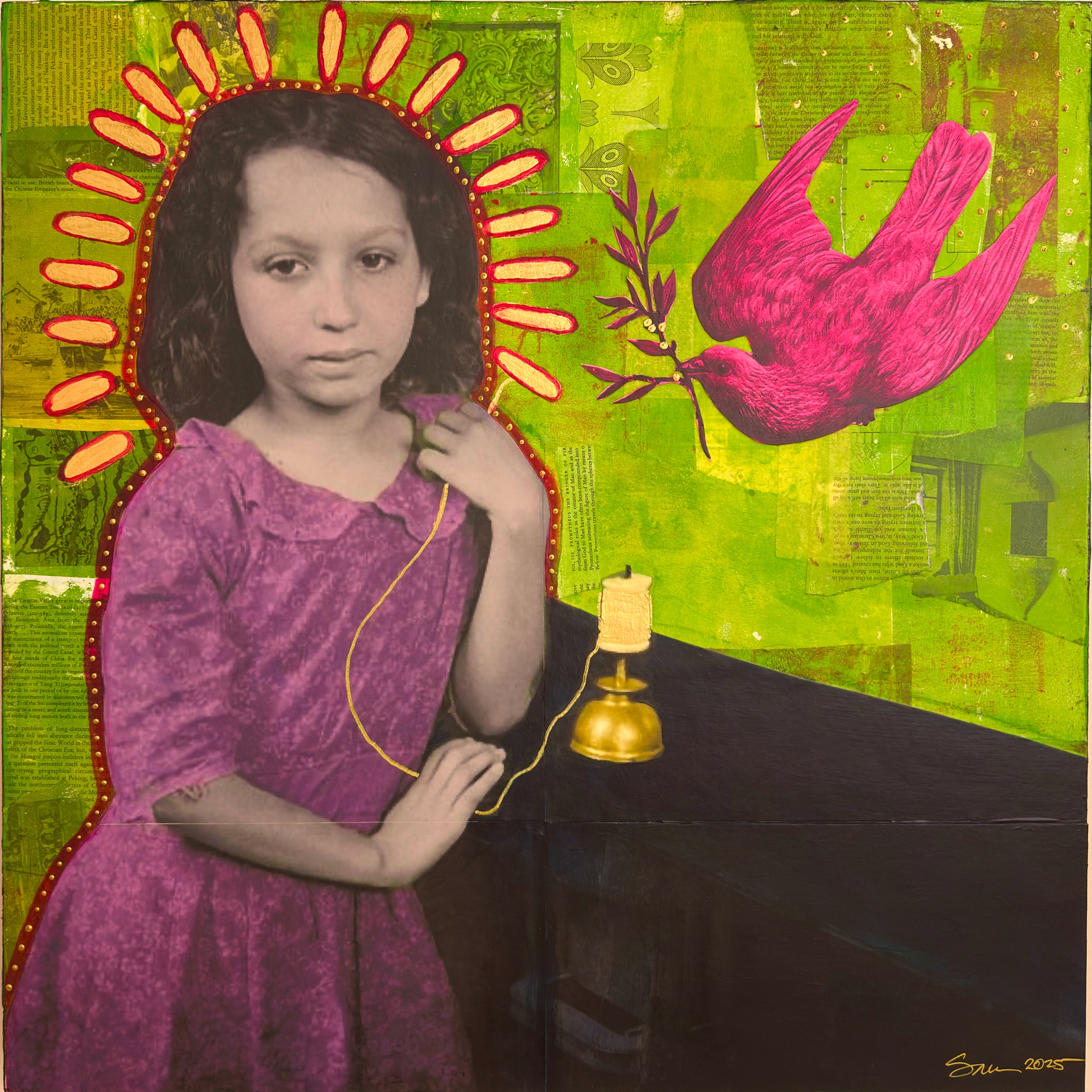
Saint Bernadette
by Sara Koenig
$900.00
Out of stock
Artist: Sara Koenig
Title: Saint Bernadette
Year: 2026
Classification: Unique
Medium Discipline: Collage
Medium/Materials: Acrylic and digitally altered pigment-printed photograph, hand-painted on canvas paper, with rice paper, torn textbook pages, and heavyweight art paper collage, gloss gel medium, isolation coat, and satin varnish on cradled wood panel.
Dimensions: 24 x 24 x 2 in.
Signature: Front, Lower Right
Exhibition Name: Before The Fall
Certificate of Authenticity: Yes, Provided by Gallery
Image Rights: © Sara Koenig Courtesy of Dama Gallery, LLC
Shipping: Paid by Buyer, not included in list price
Gallery Pick Up: Available
Sara Koenig is a mixed media artist based in Durham, North Carolina whose work explores cultural identity, ancestry, and historical memory through layered portraiture. Combining digitally manipulated photographic imagery with acrylic paint, collage, and paper transfer processes, she constructs richly textured compositions that situate figures within symbolic landscapes of past and present.
Drawing from archival photographs, historical imagery, and symbolic iconography, Koenig’s work examines how personal and collective histories continue to shape contemporary narratives of identity and belonging.
Koenig’s work has been exhibited nationally, including at Dama Gallery in Los Angeles and the Durham Art Guild. Her solo exhibition Women Past, in Present Tense will open at Golden Belt in Durham, North Carolina in spring 2026.
Koenig received her BA from Sarah Lawrence College and her MD from the University of North Carolina at Chapel Hill. She maintains an active studio practice alongside her work as a physician.
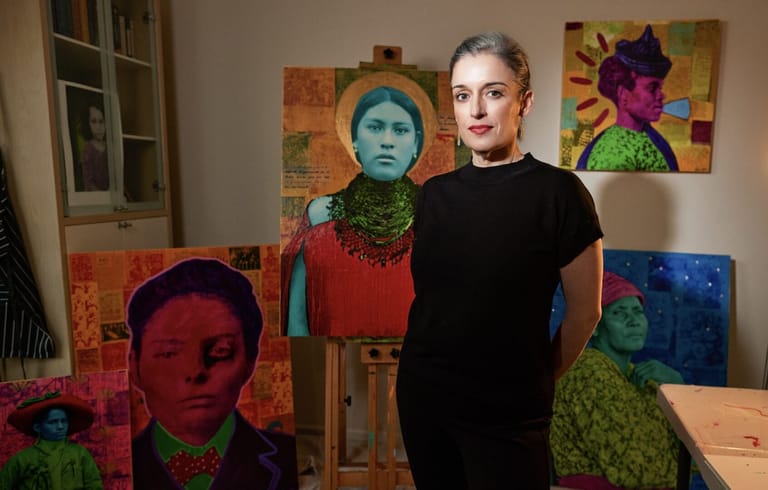
My work reanimates archival photographs through layered mixed-media processes that bring historical figures into “present tense,” exploring identity, cultural memory, and belonging. My interest in history began early. My father was a history teacher, and our home was filled with books, artifacts, and objects that carried the weight of centuries. History was something to study, preserve, and admire. It was revered and palpable, but silent, existing beside us like a mausoleum: present, but not alive.
In contrast, my work begins with a search for images that feel alive. I spend countless hours exploring digital archives and historical photographs, looking for faces that spark recognition—individuals whose gaze suggests a life still unfolding beyond the moment captured by the camera. These figures become the protagonists of my work.
Questions of identity and belonging naturally shape the way I engage with these subjects. I am a woman with Indigenous roots in the Americas as well as ancestors who immigrated through Ellis Island, and I grew up aware that identity is often formed at the intersection of multiple histories. My interest in the ways people define themselves through narrative led me to study religion and creative writing at Sarah Lawrence College and theology at Oxford University.
The figures I select from archival photographs often exist somewhere between historical record and cultural myth. Many are individuals whose identities have been simplified, obscured, or mythologized over time. By placing them at the center of my compositions, I invite viewers to encounter them as individuals of consequence rather than figures relegated to the margins of history, and to reconsider the narratives that surround them.
My process mirrors this act of historical reconstruction. I digitally alter archival photographs, isolating the figure and animating them with saturated color before printing them onto canvas or paper. I then intensify the image with acrylic paint, allowing the hand-painted surface to further transform the photographic source.
Around these figures I construct layered environments using rice paper transfers of historical imagery, fragments of books and archival materials, my own handwriting, and textured collage. These backgrounds are created through latex gel plate printing and transfer techniques that allow visual histories to accumulate across the surface. Symbols, patterns, and iconographic references emerge within these layers, echoing visual languages found in religious imagery, historical ornamentation, and cultural storytelling traditions.
As the work develops, the figure begins to shift. Removed from the strict context of the original photograph and surrounded by layered visual histories, the subject moves beyond documentation into something more symbolic. They begin to resemble icons—figures suspended between memory, myth, and contemporary interpretation.
Through this process, the past is not presented as distant or fixed. Instead, it becomes active and relational. These figures become collaborators across time rather than relics of the past. By transforming archival photographs through layered material processes, my work joins a growing body of contemporary practices that reanimate historical imagery and explore the fluid relationship between cultural memory, identity, and myth.
I think of this process as bringing the past into present tense.
Ultimately, my work explores how history lives within us—not only through documented events, but through the stories we inherit, the identities we construct, and the ways we choose to see one another. By inviting viewers into an encounter with these reanimated figures, I hope to spark moments of recognition that transcend time and speak to the universal human dilemmas we continue to face today.
-Sara
Dama Gallery is pleased to present Before the Fall, a group exhibition featuring artists working across photography, painting, collage, portraiture, landscape, abstraction, and geometric form. This exhibition examines the fragile interdependence between nature, humanity, and the systems we construct to survive within it.
Before the Fall reflects on a collective sense of suspension, an awareness that balance is never guaranteed and that harmony, once disrupted, can unravel quickly. The works in the exhibition explore moments of connection and fracture, where ecosystems, civilizations, and individuals intersect. Rather than presenting collapse as spectacle, the exhibition lingers in the tension that precedes it: the quiet instability, the warning signs, the unresolved questions.
Through varied visual languages and materials, the artists address the relationship between people and place, structure and vulnerability. Landscapes become psychological terrain; portraits suggest shared responsibility; abstract and geometric forms echo systems both natural and man-made. Together, these works create a layered narrative that underscores how deeply entwined all life remains.
While conceptually rigorous, Before the Fall is grounded in accessibility. The exhibition invites viewers to recognize themselves within the work; to reflect on stewardship, coexistence, and the consequences of imbalance. It asks not only what may be lost, but what might still be preserved through awareness and care.
© 2011-2026 Dama Gallery, LLC. All Rights Reserved